Hi everyone,
I’ve been using Portfolio Performance for a while now and I find it really useful. That said, at my level, I also find some of the performance reporting a bit hard to read. There are lots of charts, tables and figures, and even if I understand them, I don’t always find the whole thing very intuitive.
So last weekend, mostly out of curiosity, I thought: why not feed the XML to an AI and see what it comes up with? At first it was just for fun. In the end, I spent two sleepless nights on it, tried 3 different AIs, and got a surprisingly decent result: a 24-page report with tables and charts, but above all something that actually explains the portfolio in plain language and tries to analyze its performance.
I used ChatGPT Plus, Perplexity Pro and the free version of Claude. At first all three gave me a first report. Then I started having fun with it: I asked each of them to judge the other two reports.
Perplexity was clearly behind, and it more or less admitted it itself by preferring Claude’s report. GPT didn’t react very gracefully to Perplexity’s criticism, but it did recognize some strengths in Claude’s work. Claude, characteristically, thought the three approaches were different but complementary. And in the end Perplexity basically gave up and admitted GPT’s version was stronger.
In practice, the roles ended up splitting quite naturally: GPT did the actual drafting, Claude acted more like an auditor, and Perplexity gave its opinion on both. I ended up with 6 versions, a summary, and a technical annex that I’m still not sure I really needed. So yes, a lot of work for a very small portfolio. But intellectually, it was really interesting.
To give a more concrete idea of the result, here are two anonymized extracts.
First, the structured summary table :
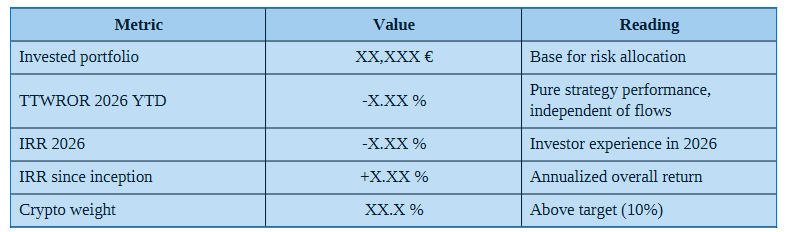
| Central diagnosis — The actual portfolio currently looks like roughly XX% World / XX% semiconductors / XX% small caps / XX% crypto / XX% French euro funds, against a target of 55/15/10/10/10. The real issue is not changing the strategy, but making sure every new euro finally serves the strategy that was already defined. |
|---|
Then the plain-language summary :
Where does the portfolio stand?
The portfolio is broadly consistent with a dynamic long-term strategy. However, the actual allocation is not yet the one being targeted: the core position is still too small, while the crypto sleeve still weighs too much.
What is working
The World ETF is doing its job well as a diversified foundation. The semiconductor conviction is coherent and performing well, even if it still remains too small within the overall portfolio.
What is a problem
The early 2026 decline mainly comes from the crypto sleeve. So it is not the core strategy that is being called into question, but its actual structure. In short: the portfolio is not badly designed, it is still badly balanced.
What needs to happen
Stop adding to crypto while it remains above target. Direct new contributions first to the World ETF, then to semiconductors, then to small caps. Less tactical tinkering, more consistent DCA.
I haven’t really seen any thread here — or anywhere in English, French or German — going into this subject in any real depth with Portfolio Performance. So I was wondering: has anyone here tried something similar? And if yes, would there be any interest in exchanging prompts and methods to improve this kind of thing, like Panini cards lol?
Or maybe it has no real interest at all and I’m the only one who found it interesting 
